The Question Every Septic System Owner Asks Eventually
It’s one of the most common questions we hear from homeowners across Dutchess County: how often does the septic tank actually need to be pumped? The answers people get vary widely, from neighbors who swear they’ve never had it done, to contractors who insist every year is the only safe interval. The confusion is understandable, and the stakes are real.
Getting the pump-out frequency right matters more than most property owners realize. Too infrequent, and sludge accumulates to the point where it flows into the drain field, triggering a chain of progressive damage that’s expensive and disruptive to reverse. Too frequent, and money is spent unnecessarily on a system that isn’t ready for service. The right answer sits somewhere in the middle, and it’s specific to each property, each household, and each system.
We’ve been servicing septic systems across the Hudson Valley since 1950, and the guidance we share in this article reflects decades of field experience combined with the best available research on residential and commercial wastewater management.
The Standard Recommendation, and Why It’s a Starting Point, Not a Rule
The most widely cited recommendation for septic tank pump-out frequency is every three to five years for a typical residential system. This guideline appears in guidance from the EPA’s SepticSmart program, in state health department publications, and in the advice of most qualified septic professionals, and it’s a reasonable baseline for planning purposes.
The guideline exists because, for an average American household of two to four people living in a home with a properly sized septic system, sludge accumulates at a rate that brings the tank to the safe service threshold roughly within that window. It’s a useful starting point for homeowners who have no service history and need somewhere to begin.
But “average household” covers an enormous range of real-world situations, and many properties in Dutchess County fall meaningfully outside that average. The three-to-five-year guideline was never intended as a universal prescription. It was always meant to be adjusted based on the specific factors that affect how quickly any individual tank fills.
The Factors That Actually Determine Your Ideal Interval
Household Size: The Most Significant Variable
The number of people regularly using a septic system has a more direct impact on pump-out frequency than almost any other factor. More people means more wastewater, more solids entering the tank, and faster sludge accumulation.
A rough framework that septic professionals use as a starting reference:
- 1 to 2 people in a home with a standard 1,000-gallon tank: pump-out every 4 to 6 years
- 3 to 4 people in the same size tank: pump-out every 3 to 4 years
- 5 to 6 people: pump-out every 2 to 3 years
- 7 or more people: annual or near-annual service in most cases
These ranges assume moderate water use and no significant aggravating factors. Households that use more water than average, multiple daily showers, frequent large laundry loads, high dishwasher use, should move toward the shorter end of the range for their household size.
Tank Capacity Relative to Household Demand
A household of six using a tank sized for a two-bedroom home is a fundamentally different situation from a household of six using a tank sized appropriately for their actual load. Tank capacity, measured in gallons, determines how much volume is available for sludge accumulation before the safe threshold is reached.
Common residential tank sizes in Dutchess County range from 750 gallons (found in very old or small properties) to 1,500 gallons or more. The larger the tank relative to the household’s wastewater output, the longer the interval between pump-outs can safely extend. This is one reason why Dutchess County NY Septic Tank Installation that’s correctly sized from the outset, based on actual bedroom count and anticipated occupancy, is such an important long-term investment. A properly sized system is simply more forgiving.
Garbage Disposal Use
This one consistently surprises homeowners: the presence and frequency of use of a garbage disposal (also called an in-sink disposer) has a significant impact on how quickly a septic tank fills with solids.
Food waste ground up and sent through the drain is organic material that enters the tank and adds to the sludge layer. Unlike human waste, which the tank’s bacterial population processes reasonably efficiently, food solids, particularly starchy, fibrous, or fatty materials, accumulate at a higher rate than the bacterial community can digest. Homes with active garbage disposals typically need pump-outs 25 to 50 percent more frequently than comparable households without them. For a household that would otherwise pump every four years, garbage disposal use might reduce that to two to three years.
The Role of What Goes Down the Drain
Beyond garbage disposals, the general category of materials entering the system affects accumulation rates meaningfully. Non-biodegradable materials, “flushable” wipes, cotton products, paper towels, cigarette filters, don’t break down in the tank. They accumulate in the sludge layer without being processed by bacteria, contributing volume without the biological reduction that organic waste undergoes.
Households where these materials are regularly introduced into the system will see faster sludge accumulation and need more frequent pump-outs. Beyond frequency, the presence of these materials sometimes creates pipe blockages that require pipe snaking and cleaning as a separate service, addressing the immediate blockage while the pump-out addresses the tank-level accumulation.
How Sludge Levels Are Actually Measured
One of the most valuable things that happens during a professional pump-out is sludge level measurement, the direct assessment of how deep the sludge layer is at the bottom of the tank at the time of service. This measurement, recorded at each visit, is what allows a qualified septic professional to make a genuinely informed recommendation about the appropriate next service interval for that specific tank.
The general safe operating threshold is that sludge should not occupy more than one-third of the tank’s total capacity. When sludge reaches approximately the one-third mark, it’s time for service, the remaining effluent zone is shrinking to the point where solids could begin flowing toward the outlet.
When a tank is pumped with sludge at 20 percent capacity, it was pumped earlier than necessary. When a tank is pumped with sludge at 45 percent capacity, it went too long. The difference between those two findings informs the next recommended interval more precisely than any generic guideline can.
This is why Dutchess County NY Septic Tank Pumping by a qualified professional, rather than a DIY or unqualified service, provides information that goes beyond the immediate service. The sludge measurement and the professional’s observation of tank conditions create a data point that makes every subsequent service decision more accurate.
Commercial Properties: A Different Set of Considerations
Why Commercial Systems Need More Attention
Commercial properties, restaurants, retail buildings, multi-family housing, event venues, offices, generate wastewater at volumes and compositions that require a fundamentally different approach to pump-out frequency than residential systems.
A commercial kitchen, for example, introduces grease, food solids, and cleaning chemicals at concentrations that residential systems never see. Grease accumulates in the scum layer at the top of the tank and, if allowed to build excessively, can flow into the drain field and cause irreversible clogging. Commercial properties with food service operations often need pump-outs every six to twelve months, or even more frequently for high-volume kitchens.
Multi-family rental properties face a different version of the same challenge: higher occupancy than a typical single-family home, potentially in a system that was originally sized for single-family use. Property managers overseeing rental buildings with private septic systems should have those systems assessed by a professional to establish an appropriate service schedule, not assume that the residential guideline applies.
For commercial properties concerned about managing wastewater loads during high-traffic periods or construction phases, portable toilet rentals provide a practical solution that keeps peak-load wastewater out of the permanent septic system entirely.
Signs That Your Tank Is Overdue, Regardless of the Calendar
Regardless of when the last pump-out was, certain signs indicate that the tank needs attention now, not at the next scheduled interval. Recognizing these signals is important because a system that’s overdue doesn’t always announce itself with dramatic failure. Sometimes it whispers first.
Warning signs that your tank may need immediate service:
- Multiple slow drains throughout the home simultaneously, not a single slow fixture, but a system-wide sluggishness that points to a downstream problem
- Gurgling sounds from toilets or drains after water is used elsewhere in the house, the sound of air being displaced backward through a pressurized system
- Sewage odors inside the home, particularly in lower-level spaces, or outside near the tank access area
- Wet or spongy ground over the drain field area, even during dry weather
- Unusually green or lush grass directly above where the drain field trenches run, a sign of effluent surfacing and fertilizing the grass from below
- Sewage backup into ground-floor or basement drains, the most urgent signal, indicating the tank is at or beyond capacity
If any of these signs are present, it’s time for an inspection and likely an immediate pump-out regardless of the maintenance calendar. If your system shows these kinds of symptoms, it might be time for an inspection, we’re always available to assess your property’s septic needs.
What Happens During a Professional Pump-Out
More Than Just Emptying the Tank
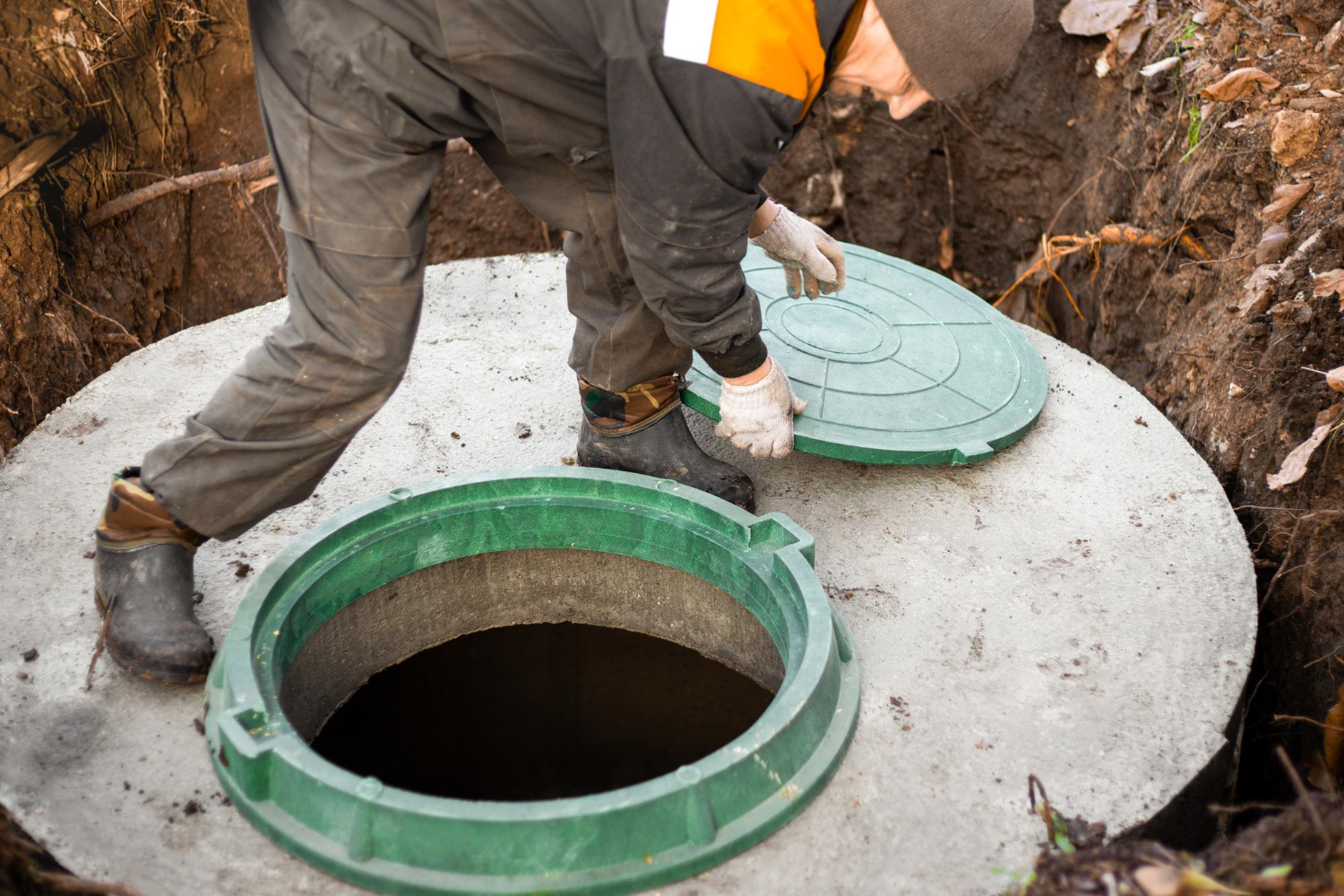
A professional pump-out is not simply a matter of connecting a hose and removing liquid. When performed correctly, it’s a service and assessment event that produces useful information about the system’s condition.
During a standard pump-out, a qualified technician:
- Locates and opens the tank access points (on properties where the tank location isn’t marked or documented, tank locating is part of the service)
- Measures sludge depth before pumping to establish the current accumulation level
- Removes the full contents of the tank, sludge, scum, and effluent, not just the liquid layer
- Inspects the accessible interior of the tank, including the inlet and outlet baffles, for signs of deterioration
- Notes any observations about tank condition, cracks, corrosion, root intrusion near the lid, or other concerns
- Documents the service with a record that becomes part of the property’s maintenance history
The baffle inspection component is worth highlighting specifically. Baffles, the internal plastic or concrete structures that direct incoming wastewater downward and prevent the scum layer from exiting, are components that homeowners never see and rarely think about. They deteriorate over time, and a failed outlet baffle allows the scum layer to flow directly into the drain field, causing accelerated clogging that shortens field life significantly. Catching baffle deterioration during a routine pump-out and addressing it with a Dutchess County Septic Tank Repair, a baffle replacement is a relatively modest intervention, prevents the far more expensive drain field damage that follows.
The Value of Combining Pumping With Cleaning and Inspection
A pump-out is the core maintenance event, but it’s not the only service that benefits from being performed on a consistent schedule. Two additional services complement pump-outs in ways that extend system life and provide more comprehensive information about system health.
Dutchess County NY Septic Tank Cleaning goes beyond standard pumping to address residue accumulation on the tank walls and around the baffle structures. Over time, this residue can impair the biological environment inside the tank and interfere with proper flow dynamics. Periodic cleaning, not necessarily at every pump-out, but incorporated into the maintenance cycle, addresses what pumping alone leaves behind.
Dutchess County NY Septic Tank Inspection provides a comprehensive evaluation of every system component: tank structure, baffle condition, pipe connections, and drain field health. The New York State Department of Health recommends periodic professional inspection as part of responsible system management, noting that inspection catches developing problems before they reach the level of component failure.
Combining a pump-out with a cleaning and inspection at the same service visit is efficient and provides the most complete picture of system health at any given point in time. We recommend this combination every three to five years for most residential systems, adjusted based on the household-specific factors discussed earlier.
Building a Maintenance Plan That Works for Your Property
The most useful outcome of reading this article isn’t a specific number of years, it’s a framework for thinking about your own property’s needs. Start with the baseline guideline of three to five years, then adjust based on:
- Household size, more people, shorter interval
- Tank size, smaller tank relative to occupancy, shorter interval
- Garbage disposal use, active use warrants a shorter interval
- Water usage habits, high usage (concentrated laundry days, multiple daily showers) warrants a shorter interval
- System age and history, older systems or those with unknown maintenance histories warrant earlier service and more frequent inspection
- Any current warning signs, symptoms warrant immediate evaluation regardless of the schedule
The CDC’s guidance on onsite wastewater treatment reinforces that household behavior and usage patterns are the most controllable factors in septic system health, and that understanding those patterns is the foundation of a realistic maintenance plan.
For property owners who aren’t sure where to start, a professional inspection establishes a current baseline, sludge levels, system condition, baffle status, drain field health, and gives a qualified technician the information needed to recommend an interval that reflects actual conditions rather than a generic estimate.
Wondering whether your tank is due for a pump-out? Let’s talk. Whether your last service was two years ago or twelve, we can assess where the system stands and help you build a schedule that protects the system and fits your life. We’re always available to assess your property’s septic needs, and helping homeowners across Dutchess County stay ahead of septic problems is exactly what we’ve been doing for over 70 years.
